
License Types: Understanding Software and Content Licensing
2 months ago
- What Are Licenses and Why Do They Matter?
- High-Level Categories of License Types
- Permissive Open Source Licenses
- Copyleft Licenses
- Public Domain and Public Domain–Like Licenses
- Creative Commons License Types
- Dual Licensing Models
- Source-Available Licenses
- How to Choose the Right License Type
- License Types and Open Source Governance
- EEAT Perspective: Why Licensing Knowledge Builds Trust
- Common Misconceptions About Licensing
Understanding license types is essential for anyone involved in creating, distributing, or using software and digital content. Licenses define the legal framework that governs how code, documentation, media, and data can be used, modified, and shared. Without a clear understanding of licensing, individuals and organizations risk legal uncertainty, compliance issues, and lost opportunities for collaboration.
What Are Licenses and Why Do They Matter?
A license is a legal agreement that grants permission to use intellectual property under specific conditions. By default, copyright law restricts all use unless explicitly permitted. Licenses exist to clearly define those permissions and limitations.
In software and open source ecosystems, licenses:
- Define user rights and responsibilities
- Enable collaboration and distribution
- Protect creators and contributors
- Reduce legal and compliance risks
Choosing the correct license is not just a legal formality—it is a strategic decision that shapes how a project grows and how others can engage with it.
High-Level Categories of License Types
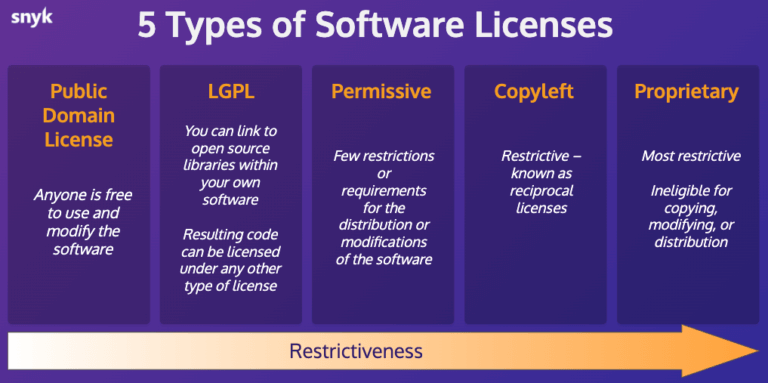
While there are many individual licenses, most fall into a small number of broad categories. Understanding these categories makes it easier to evaluate specific licenses later.
1. Proprietary Licenses
Proprietary licenses restrict access to source code and limit usage rights. Users are typically granted permission to use the software under strict conditions, often outlined in an End User License Agreement (EULA).
Common characteristics include:
- No access to source code
- Restrictions on modification and redistribution
- Commercial usage terms defined by the vendor
Examples include commercial operating systems, enterprise software, and many SaaS platforms.
2. Open Source Licenses
Open source licenses allow users to access, modify, and distribute source code under defined conditions. These licenses are reviewed and approved by the Open Source Initiative (OSI).
Open source licensing promotes transparency, collaboration, and innovation across global communities.
Permissive Open Source Licenses
Permissive licenses offer minimal restrictions, making them attractive for broad adoption and commercial use.
Key Characteristics
- Allow proprietary derivative works
- Minimal compliance requirements
- Simple attribution obligations
Common Examples
- MIT License
- BSD Licenses
- Apache License 2.0
These licenses are frequently used in libraries, frameworks, and infrastructure tools where widespread reuse is encouraged.
Copyleft Licenses
Copyleft licenses require derivative works to be distributed under the same license terms. This ensures that software remains open and accessible over time.
Strong Copyleft
Strong copyleft licenses apply their terms to all derivative works, including combined or linked software.
- GNU General Public License (GPL)
- Affero General Public License (AGPL)
Weak Copyleft
Weak copyleft licenses apply only to modifications of the licensed components.
- GNU Lesser General Public License (LGPL)
- Mozilla Public License (MPL)

Public Domain and Public Domain–Like Licenses
Some licenses aim to place works as close to the public domain as possible.
Examples
- CC0 (Creative Commons Zero)
- The Unlicense
These licenses waive copyright claims, allowing unrestricted use with no attribution requirements. However, enforceability varies by jurisdiction.
Creative Commons License Types
Creative Commons licenses are commonly used for documentation, media, and educational content rather than software.
Key Variants
- CC BY (Attribution)
- CC BY-SA (ShareAlike)
- CC BY-NC (Non-Commercial)
- CC BY-ND (No Derivatives)
Dual Licensing Models
Dual licensing allows a project to be distributed under two different licenses, typically one open source and one commercial.
This model enables:
- Community collaboration through open source
- Commercial monetization through proprietary terms
Dual licensing is common in database systems, developer tools, and enterprise-focused projects.
Source-Available Licenses
Source-available licenses provide access to source code but do not meet the Open Source Definition.
These licenses often restrict:
- Commercial usage
- Redistribution
- Hosting as a service
While transparent, they should not be confused with true open source licenses.
How to Choose the Right License Type
Selecting the right license depends on project goals, audience, and long-term strategy.
Key Considerations
- Do you want derivatives to remain open?
- Is commercial adoption a priority?
- Do you need patent protection?
- What ecosystem will use your project?
Organizations should involve legal counsel and consider governance frameworks when making licensing decisions.
License Types and Open Source Governance
Licensing is a cornerstone of open source governance. Foundations and communities rely on clear licensing to manage contributions, enforce compliance, and maintain trust.
Organizations like the OuterCurve Foundation emphasize licensing clarity as a prerequisite for sustainable open source ecosystems.
EEAT Perspective: Why Licensing Knowledge Builds Trust
From an EEAT standpoint, understanding license types demonstrates:
- Expertise: Knowledge of legal and technical implications
- Experience: Practical application in real-world projects
- Authoritativeness: Alignment with recognized standards
- Trustworthiness: Transparent usage and distribution terms
Clear licensing supports ethical software development and long-term collaboration.
Common Misconceptions About Licensing
“Open source means no restrictions”
Open source licenses include obligations that must be followed.
“One license fits all projects”
Different projects require different licensing strategies.
“Licenses only matter at release time”
Licensing impacts contributions, adoption, and compliance throughout a project’s lifecycle.
Understanding license types is fundamental to building, sharing, and sustaining software and digital content. Licensing decisions influence collaboration, adoption, and legal certainty across ecosystems.
By choosing the right license and applying it correctly, creators and organizations can foster innovation, protect contributors, and build trust with users and partners.